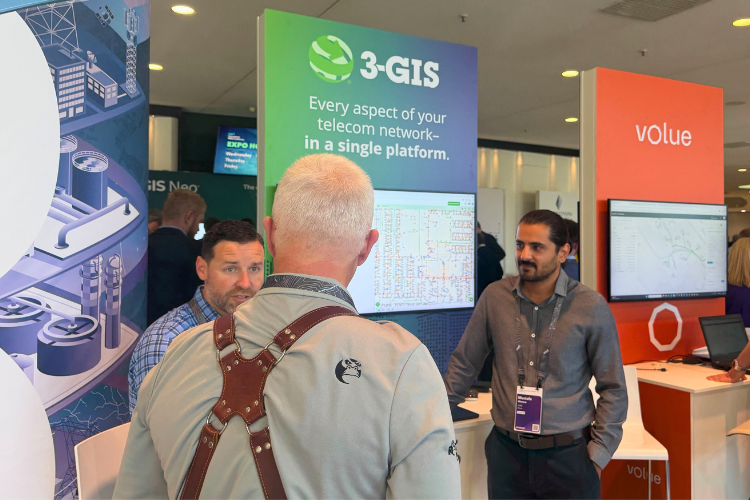

Last month, I had the opportunity to attend Esri's Telecom Domain Network (TDN) Knowledge Transfer session in Rotterdam. While others from the 3-GIS team have attended two separate Knowledge Transfer sessions in Redlands, CA in 2025, this was my first exposure to the model at a deep technical level, working directly with the Esri team and other partners who are actively engaging in its evolution.
One of the most important takeaways for me was how clearly Esri is positioning TDN as a foundational framework rather than an out-of-the-box telecom solution. TDN provides a modern, abstract information model intended to support telecom use cases over time, while leaving room for partner solutions to deliver the advanced workflows, domain logic, and user experience that customers rely on today.
That distinction matters, and it came through clearly in the technical discussions. Much of the session focused on how connectivity, unit IDs, grouping, circuits, and versioning are represented at the core model level. These are not new telecom concepts, but rather new ways of expressing them within Esri's platform in a way that is more flexible and future oriented.
The conversations were intentionally deep and pragmatic. We discussed what is available today, what is still evolving, and where partners are expected to extend the framework. I appreciated the openness around current maturity levels, tooling and advanced scenarios. The message was consistent: TDN is meant to be built upon, not used in isolation.
Why this matters to users
For users, TDN is not about suddenly gaining capabilities that were previously impossible. Many mature telecom solutions already support sophisticated modeling, design, and operational workflows today. What TDN offers is a stronger, more modern foundation within the Esri ecosystem that those proven capabilities can align with and extend over the long term.
This matters because users want:
- Confidence their data model aligns with Esri's direction
- Flexibility to adopt platform advances without losing critical functionality
- A path forward that avoids repeated migrations or disruptive re-implementations
TDN creates that path by separating the core network framework from the solutions that implement telecom intelligence on top of it. Users continue to rely on partner solutions for real-world telecom needs, while benefiting from a platform that is evolving to better support scale, performance, and extensibility.
Laying the groundwork for what comes next
For partners, TDN represents an opportunity to bring existing, production-proven telecom functionality and workflows onto a modern platform foundation, rather than reinventing it. The value is not in replacing what already works, but in aligning it with where Esri is going.
Attending this session reinforced the importance of that balance. The future of telecom GIS is not about waiting for a single platform to do everything. It's about combining a strong core framework with deep domain expertise, delivered through partner solutions that understand how telecom networks actually operate.
I came away from Rotterdam encouraged by the direction, grounded by the technical realities, and excited about how this foundation can support the next phase of telecom products built on Esri technology. The groundwork is being laid carefully, and that’s exactly what users need.