
At some point in almost every transformation conversation, someone will say, “We just need a digital twin”. It sounds like the right answer. It signals progress, modernisation, and ambition. Yet in practice, what usually follows is far less transformative; dashboards that look impressive but change little, pilot projects that never quite scale, and operational teams quietly returning to spreadsheets once real-world complexity sets in.
The problem is rarely the absence of technology. Far more often, it is that the underlying systems do not agree on reality. When different parts of the organisation operate from different versions of the truth, no amount of visualisation or automation can compensate.
Growth outpaces operational maturity
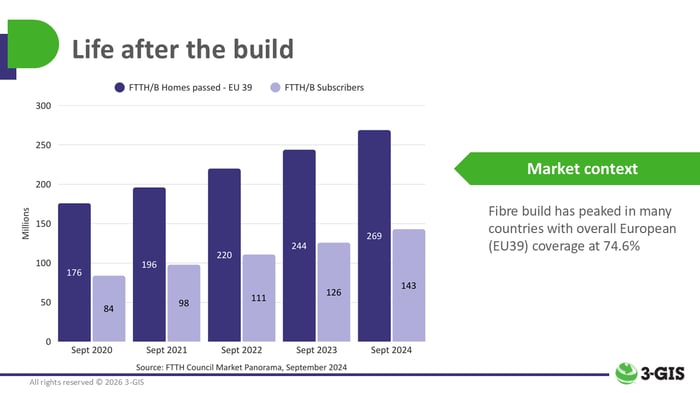
There is no question that enormous progress has been made in network build. Across Europe (EU39), fibre coverage has reached 74.6% of homes, with take-up now just over 53%, according to the FTTH Council.1 In many markets, the infrastructure itself is largely in place.
The same pattern can be seen well beyond Europe. In Oman, Oman Broadband has passed more than 880,000 covered units and now supports over 300,000 active fibre subscribers.2 In Saudi Arabia, fibre has expanded to nearly four million homes, driven by large-scale national programmes.3 In Jordan, household internet access exceeds 96%, yet fully operationalised fibre still trails behind headline access figures.4
Different markets, different contexts, but a strikingly similar reality. Coverage expands rapidly, while operational maturity often struggles to keep pace. As rollout activity slows and attention turns inward, more difficult questions begin to surface. Do we truly understand what has been built? Can we trust the data that underpins everyday decisions? And are we actively operating the network, or constantly compensating for gaps and inconsistencies?
When systems disagree, trust breaks down
Having worked hands-on with telecom GIS across national fibre delivery programmes, live operational environments, and now in daily support of operators, the pattern is remarkably consistent. Planning teams see one version of the network, delivery teams work from another, and assurance relies on a third. Each system makes sense in isolation. Together, they rarely tell a coherent story.
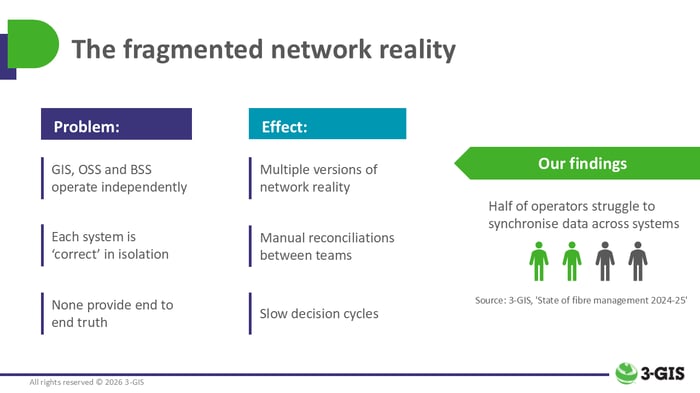
When that happens, organisations adapt in predictable ways. Extra checks are added “just in case.” Manual reconciliations become routine. Shadow spreadsheets emerge to bridge gaps between systems. Over time, these workarounds stop being temporary fixes and quietly become the process itself. While this behaviour feels safe in the short term, it introduces long-term cost, fragility, and delay into the organisation.
Integration with purpose
This is where many transformation initiatives lose their way. Integration is often treated as a technical exercise, focused on architecture diagrams, APIs, dashboards, and feature lists. All of these have their place, but none of them address the real issue on their own.
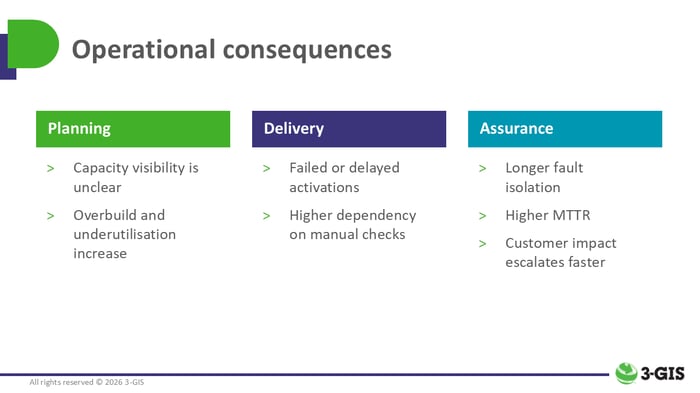
If integration does not remove real operational friction, then it is not integration. The questions that matter are not about features, but about outcomes. Why do service activations still fail on a network that is supposedly built? Why do delivery teams feel the need to double-check inventory instead of trusting it? Why does assurance remain reactive rather than predictive? These are operational problems, not technology gaps.
Foundations before connections
One of the most common mistakes is attempting to integrate systems before the foundations are stable. Before any meaningful integration can occur, there must be clear ownership of physical inventory, service logic, and commercial data, with no ambiguity about responsibility. Update flows need to be embedded into real operational work, not deferred to periodic clean-up exercises. Validation rules must actively prevent bad data from spreading, and feedback loops must genuinely close when issues are identified.
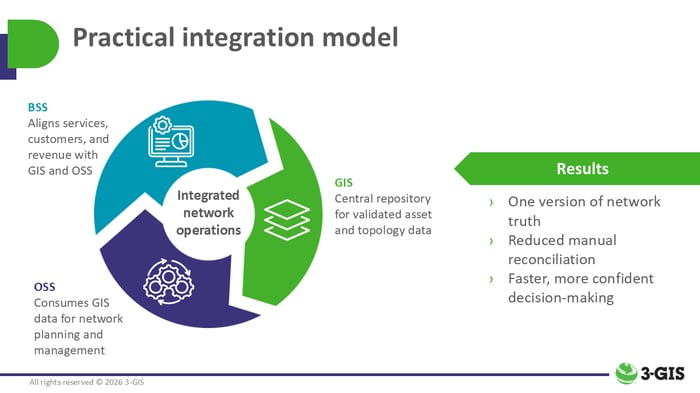
None of this is particularly glamorous, yet it is essential. Without these fundamentals, integration simply accelerates the movement of uncertainty across systems rather than eliminating it.
Where the truth must live
For network inventory, the system of truth must sit as close as possible to physical reality. In practical terms, that means GIS. Not because it is “a map,” but because it is the only place where assets exist in space, connectivity and topology can be validated, and capacity and constraints can be consistently enforced.
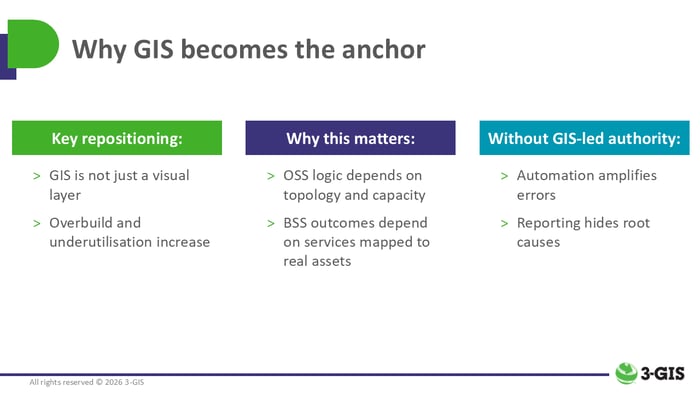
Operational support systems depend on that physical reality to function correctly. Business support systems depend on it to monetise services without mismatch or leakage. When GIS is treated as optional or secondary, the outputs of OSS and BSS rapidly lose reliability and meaning.
Digital twins are earned, not bought
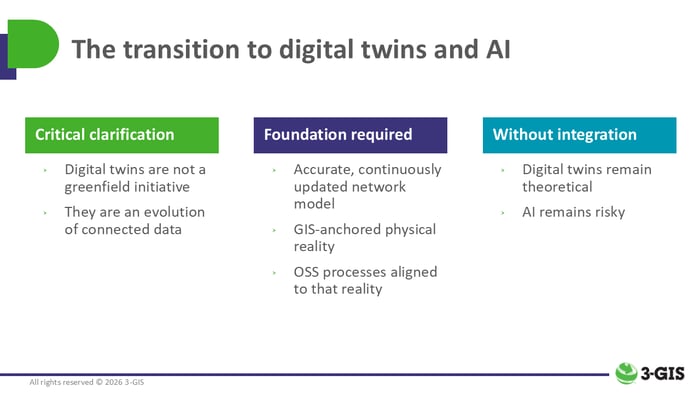
This is where expectations often need to be reset. Digital twins are not products that can simply be installed. They are the result of trusted data, disciplined operational processes, and systems that are genuinely aligned. Without a continuously updated and reliable network model, digital twins remain theoretical, AI introduces risk rather than value, and automation amplifies errors instead of removing them.
The technology works. But only when the foundation does.
Getting the order right
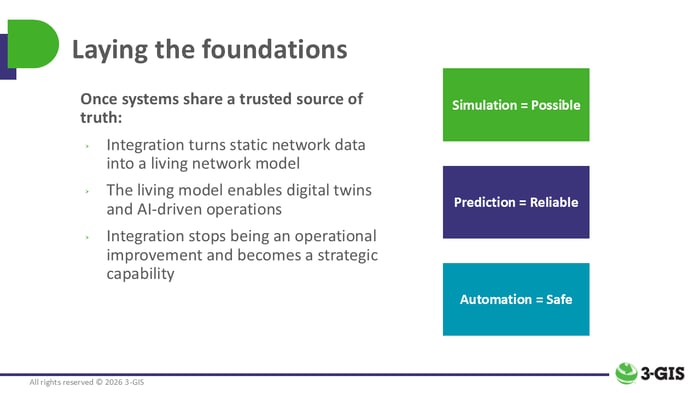
Across real-world deployments, the successful pattern is clear. First, stabilise and build trust in the network inventory. Next, align OSS processes to that physical reality. Only then should BSS and commercial logic be tightly coupled to the operational layer. When this sequence is ignored, organisations simply automate confusion. When it is followed, everything downstream becomes faster, safer, and easier to manage.
The bigger picture
This challenge is not unique to telecoms. Water, electricity, gas, and other asset-intensive utilities face the same underlying issue. The future is not unlocked by adding yet another layer of technology, but by fixing the ones underneath.
AI, digital twins, and even agentic operations all assume one deceptively simple condition: that systems are aligned on a single version of reality. The most important question is, not how advanced the technology roadmap looks, but whether the organisation’s systems are genuinely telling the same truth or simply offering very polished explanations of different ones.
This blog post is based on the recent webinar, Beyond the build: Turning connected network data into business intelligence. Watch on demand here.
Citations:
1 FTTH Council Europe. “European FTTH/B Market Panorama Report 2025”, March 19, 2025. https://www.ftthcouncil.eu/resources/all-publications-and-assets/2358/european-ftth-b-market-panorama-2025
2 Oman Broadband. “About Us”, 2026. https://omanbroadband.om/about-us/
3 Abbas, Mohamed. “Saudi Arabia Fixed Broadband Experience”. Opensignal, February 2026. https://insights.opensignal.com/reports/2026/02/saudiarabia/fixed-broadband-experience#:~:text=Market%20Overview,FTTH%20upgrades%20in%20urban%20areas
4 The Ministry of Digital Economy and Entrepreneurship. “Household Use and Penetration of Communications and Information Technology Survey 2024”, January 27, 2026. https://pt1.petra.gov.jo/en/news/household-internet-access-in-jordan-reached-965-in-2024-survey-reveals#:~:text=Household%20Internet%20Access%20in%20Jordan%20Reached%2096.5%25%20in%202024%2C%20Survey%20Reveals,-27/01/2026