New Blog Test | The inspection-to-repair gap: What utilities get wrong after crews leave the field (Clone)
Most utility field crews are doing the work. They're patrolling equipment, running detail inspections on cycle, logging what they find. The...


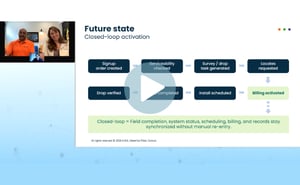
Faster installs depend on more than speed. Watch how connected orders, field work, and network records keeps Waterloo Fiber moving from request to activation.
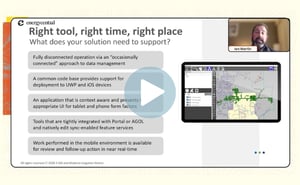
Inspection findings should not sit in reports. Watch how Modesto Irrigation District moves field findings into repair assignments teams can act on.
5 min read

Most utility field crews are doing the work. They're patrolling equipment, running detail inspections on cycle, logging what they find. The inspection program exists. The schedules are set, crews go out, and yet, things still fail.
Poles that were flagged deteriorate further before anyone touches them. Transformers that failed an inspection cycle sit in a queue that nobody's actively managing. Emergency repair crews roll out at 2 a.m. to fix something that was documented months ago. The costs pile up, not because the utility isn't inspecting, but because inspections and repairs are operating as two separate, disconnected systems.
This is the gap that rarely gets named: documentation and repair are not the same workflow. For many utilities, they're not even in the same system.
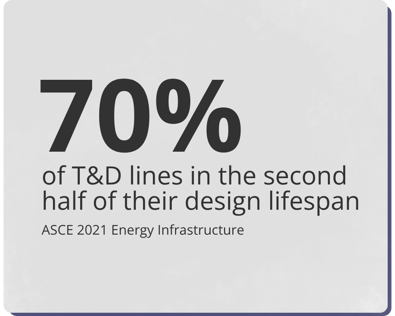
The American Society of Civil Engineers gave U.S. energy infrastructure a D+ in its 2025 Infrastructure Report Card.¹ Over 70% of transmission and distribution lines are well into the second half of their lifespans, with many components operating beyond their 50-year design life.² That's the asset base utilities are inspecting right now. Aging equipment, under increasing load, in a regulatory environment that expects documentation and repair to happen on schedule.
The inspection program is the mechanism that manages that risk. When the link between documentation and repair breaks down, the risk doesn't disappear. It just goes unmanaged.
An inspection generates information. A crew drives a route, examines a pole, notes a defect. That data has value only if something happens with it. The inspection is the trigger. The repair is the outcome. Between those two things, there's a chain of handoffs: the defect gets logged, a repair request gets created, someone routes it to the right crew, that crew gets dispatched, the work gets done, and both records get updated to reflect the closed loop.
That chain is where things fall apart.
On paper-based systems (and plenty of utilities are still closer to paper than they'd like to admit) every link in that chain is a manual step. Which means every link is a place where something goes missing. A repair tag doesn't get written. A form doesn't make it back to the office. A crew completes a repair but no one closes out the original inspection record. Now you have an open defect on equipment that's already been fixed, and a failed inspection that looks unfulfilled come audit time.
Even utilities that have moved off paper face a version of this. A mobile field tool for inspections and a separate work management system for repairs sounds like progress. But if those systems don't exchange data in real time, the gap persists. The information just lives in two silos instead of one stack of forms.
The most visible cost is reactive maintenance. When failed inspections don't generate timely repairs, equipment runs past its safe operating window. The issue that could have been addressed with a scheduled work order becomes an emergency, with the added costs of emergency labor rates, after-hours premiums, and rush parts sourcing. Those costs compound quickly across a large service territory.
 There's also the reliability impact. For a utility managing tens of thousands of facilities on multi-year inspection cycles, even a modest drift toward reactive work creates real service risk for customers.
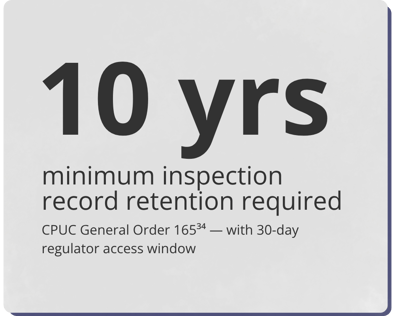
Then there's compliance. In California, CPUC General Order 165 requires electric utilities to conduct patrol inspections annually, detail inspections every 3 to 5 years depending on equipment type, and submit annual reports to the commission under penalty of perjury.³ Inspection records must be maintained for a minimum of 10 years and made available to regulators within 30 days of a request.⁴ That's not a documentation preference. It's a legal obligation. When the connection between inspection records and repair records is unclear or broken, satisfying an audit becomes a reconstruction project rather than a records retrieval.
And the harder-to-quantify cost: the crews themselves. Field workers who are asked to document problems they know won't be acted on quickly lose confidence in the process. That's a usability problem, not a technology problem. If the tools don't close the loop, the people using them stop trusting that the loop is worth closing.
The instinct at most utilities, when inspection tracking breaks down, is to improve the forms. Add more fields. Require more data at capture. Build a better report.
That doesn't solve the problem. The problem isn't the quality of documentation at the point of inspection. It's that inspection and repair are treated as separate processes rather than two steps in a single workflow.
A connected workflow means that when a crew flags a defect in the field, a repair assignment is generated automatically. It's linked directly to that inspection record, routed to the right department, and prioritized based on severity. The inspection and the resulting work order share the same asset identifier. Progress on the repair is visible in the same place where the inspection data lives. Nothing gets lost in translation between systems.
This also changes what managers can see. Instead of trying to reconcile records from two different tools, operations leadership gets a live view of inspection coverage: what's complete, what's outstanding, what defects are still waiting on repair, which repairs are overdue.
Modesto Irrigation District serves over 133,000 customers across California's Central Valley. They run patrol inspections on all 45,000 facilities every year, plus detail inspections on 3-year and 5-year cycles. Before they connected their inspection and repair workflows through a GIS-based mobile system, the process ran on paper. Missed inspections, unclear repair status, reactive maintenance, and compliance risk were all real problems.
The shift wasn't just about going digital. It was about closing the loop. When a patrol crew identifies a defect, a repair tag is generated immediately, tied to the same asset record as the inspection. High-priority repairs surface at the top of the assignments queue, so crews know what's most urgent without anyone making a phone call. Supervisors can see inspection coverage on a map in real time rather than waiting for paper to come back to the office.
The result: MID shifted from reactive to planned. Inspections happen on time. Defects get addressed before equipment fails. Audit requests get answered in a few clicks. The approach worked well enough on the electric side that MID is now rolling out the same connected workflow for its irrigation water infrastructure.
If you're running an inspection program right now, the right question isn't whether your crews are doing their jobs. They probably are. The question is: what happens to the data they collect?
Is every failed inspection automatically generating a repair request? Is that request linked to the inspection record? Can you tell, right now, which repairs are outstanding and how long they've been waiting? Can you answer that in an audit without reconstructing it manually?
If the answer to any of those is no, or "I'd have to check," the gap is there. The inspection program is running. The connection between inspection and action isn't.
We recently hosted a webinar with Modesto Irrigation District on this exact problem: the gap between documentation and repair, and what a connected inspection workflow looks like in practice. If this is a challenge your team is navigating, it's worth watching. [Watch the on-demand replay → Turning inspections into action: Closing the gap between documentation and repair
¹ American Society of Civil Engineers. "2025 Report Card for America's Infrastructure." 2025. https://infrastructurereportcard.org
² American Society of Civil Engineers. "Energy Infrastructure." 2021 Report Card for America's Infrastructure. 2021. https://2021.infrastructurereportcard.org/cat-item/energy-infrastructure/
³ California Public Utilities Commission. "General Order 165: Inspection Requirements for Electric Distribution and Transmission Facilities." https://docs.cpuc.ca.gov/PUBLISHED/GENERAL_ORDER/159182.htm
⁴ California Public Utilities Commission. "General Order 165: Inspection Requirements for Electric Distribution and Transmission Facilities." https://docs.cpuc.ca.gov/PUBLISHED/GENERAL_ORDER/159182.htm
Most utility field crews are doing the work. They're patrolling equipment, running detail inspections on cycle, logging what they find. The...

Network news roundup May's fiber and broadband news reflected a global industry moving fast. Many publicly funded programs produced their first real...
Fiber Connect 2026 confirmed what teams across the industry are already feeling: the U.S. fiber build is still very much in motion. Across the show...